During my 10 months in South America, the Dog.O.Mobil had proven itself, and I now have a better understanding of its strengths and weaknesses. When planning my next trips, I decided that I would need a vehicle that could handle rough terrain better
So why do I provide this update. I wanted to show you how, in my case, a 3-month plan ended up taking 6 months to complete, and what all went wrong for me.
What You'll Find in This Post
I wrote this article in August 2026, and I'll summarize the first year of my search for a 4x4 RV
Disclaimer: Below company links are here not because I’m being paid for them, but because in some cases I spent a very long time searching for the information and would like to give others a starting point. Please bear in mind when this post was published and note that no guarantee is given as to the accuracy of the content or external links.
Every beginning is hard—here's why
During my 10 months in South America, the Dog.O.Mobil had proven itself, and I now had a better understanding of its strengths and weaknesses. Aside from the way I’d built the living compartment, what really stood out were its length and rear-wheel drive.
At about 750 cm and with a long limited slope angle, it’s just not the most maneuverable vehicle and tends to scrape the ground easily. The 290 cm height wasn’t really a problem, since you’re always going to get a few scratches. And to be honest, back in Germany I also found more scratches and dents on the bottom 80 cm of the Sprinter. I had them spray-painted with Raptor, and that was inexpensive. With Giuseppe’s help, I did that at home, too.
Even with the ARB compressor, the sand plates, and the BFGoodrich AT tires <which lasted about 45'000 km>, I couldn’t avoid getting the Dog.O.Mobil stuck six times. It just doesn’t like sand and mud.
I also took the Dog.O.Mobil to the shop. In addition to new tires, I had to replace the brake pads and rotors, as well as two new control arms and tie rods. I still need to check the driveshaft bearing and the oil pan. South America just comes at a price.
Since I wanted to hit the road again, I decided to get a 4x4 vehicle. If I’d only been driving around Europe, I would have stuck with the Sprinter. But I wanted to go to Africa, the Middle East, and Asia.
Let's get started
In August 2025, I began my research. I ruled out modern vehicles with AdBlue and lots of electronics. The less technology, the better! Sprinters with Iglhaut or Achleitner conversions, Ivecos with SCAM technology, and 7.5-metric-ton trucks built before 2010 were at the top of my list. I had initially set my total budget at 200'000 EUR (even though that was way too expensive for me)
Four months later, after various test drives, I still hadn’t found what I was looking for or able to afford. The prices being asked for Sprinters and Ivecos were more than I was willing to pay. If they bore the Bimobil, Bocklet, Woelcke, etc., brands, premium prices were being demanded for used models.
In the meantime, I’d toyed with the idea of a new Toyota LAND CRUISER J79D SC with a camper body from one of the well-known manufacturers, but a J79D starts at around 90 TEUR (new), and there weren’t any used ones on the market. With the camper body and modifications, the price quickly climbed to 175 TEUR and beyond. It would actually have been the perfect vehicle, but after a few inspections, I wouldn’t have been able to hit the road until late 2027.
What did I look at? There were MAN, Mercedes-Benz, and Iveco fire trucks, Varios, Unimogs, and a Renault. All had under 50,000 km on the odometer, were built before 1999, and some had “H” license plates. These included fully equipped vehicles with large cabs and lengths well over 7 m. While they had plenty of interior space, some weren’t really designed for months-long trips. Then there were vehicles that were essentially “mobile construction sites,” where I couldn’t predict whether I’d ever get them registered, and the cost was impossible for me to estimate. Many of the vehicles also had the same problem: driving them was hard, noisy work.
Before Christmas, Mercedes-Benz Atego 1018 vehicles from the German Armed Forces came onto the market. Manufactured in 2008 and 2009, with mileage between 18'000 km and 50'000 km, they were in good shape (at least the ones I’d seen).
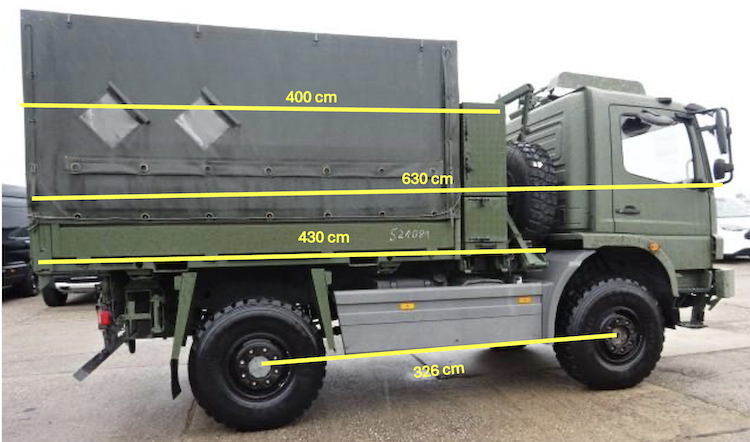
That meant a 10.5 metric tons truck I was not allowed to drive. But reducing the load to 7.5 metric tons was theoretically possible. After some research and a few setbacks, I finally found the SÄK.EL at the GEGNER car dealership near Leipzig after six months, and they even delivered it to my home—or rather, to AluStar.
Why AluStar in Murg?
I had two companies on my shortlist with whom I could do the conversion “together.” Doing some of the work myself was important to me in order to keep costs down and to be able to repair the vehicle if necessary.
AluStar is only 12 km away from my home town. Initially, I did not understand how complicated it could get to speak to the experts using a vocabulary that I am not familiar with, but I learned as I went along. Ultimately, it was easier to discuss topics face-to-face in order to find a solution. Therefore being at the workshop was important
Theyhelped me with all sorts of clarifications in the weeks leading up to the purchase. Without that support, I wouldn’t have bought the Atego and probably wouldn’t have been able to complete the conversion either.
More information in the coming months can be found⇒ 2026 & WSB
Latest Articles

Finally Cartagena after 30'700 km
The drive north from Al Bosque Camping didn't go as I had imagined right from the start. I had had enough of dirt roads since NP Angel and wanted to spend my last few weeks on paved roads.

Closer to the end - South Colombia till Medellin
At the border between Ecuador and Colombia, in Puente Internacional de Rumichaca, I spent most of my time trying to find a parking space on the Ecuadorian side.

Ecuador - La Balsa to Tulcan
I crossed the border to Ecudor at La Balsa. Customs in Peru took 10 minutes, as did immigration in Ecuador. Adounas Ecuador then took almost 1.5 hours.

Lima to Ecuador
The Dog.O.Mobil was only a little dusty when I picked it up near the airport. Jose Luiz, the owner, had even sent me a video that weekend. He took his job seriously.